Cyber Security Articles

Nine out of ten security breaches originate with defects in software code. This reality puts pressure on developers, and the
By Ray Overby   There’s a scene in “Jurassic Park” where a Tyrannosaurus rex chases after Jeff Goldblum and Laura
Hunter S. Thompson opened his classic political book Fear and Loathing on the Campaign Trail ‘72 with the question, “Is
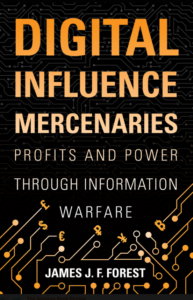
Digital Influence Mercenaries: Profits and Power Through Information Warfare by James J. F. Forest  (Naval Institute Press) is part of
The scourge of ransomware is having an increasingly serious impact on real life. A spate of recent attacks is affecting
There's no doubting that we live in an era unlike any other in human history. Technology has always driven human
In my day job as a content writer in enterprise tech and cybersecurity, I often write about the potential of
Bombarded: How to Fight Back Against the Online Assault on Democracy, by Cyrus Krohn, with Tom Farmer, takes on an
by Mila Bera The digital revolution transformed the dynamics of communication, and several governments responded to these changes by further
by Steve Freidkin One of the most insidious cybersecurity schemes today, ransomware is projected to have cost over $20 billion

Cyber Security Articles


What This Cyber Security Articles Page Is About
The goal of Journal of Cyber Policy is to provide commentary and stimulate conversations about important cyber security topics. Our parallel goal is to discuss cyber issues in plain English, liberating this critical subject from the exclusive realm of specialized engineers and hackers. Throughout, we try to talk about cyber security and related issues from the perspectives of public policy, national security, corporate policy and compliance.


Why Articles about Cyber Security Matter

We are living in an era where digital technology dominates so much of our lives. Digital risk naturally accompanies this reality. Smartphones, the IoT, the Internet and so forth make our lives easier, but they also expose us to threats. Some of these threats come from nation state actors. We believe Americans could be better-informed about these risks. And, while there’s certainly no lack of content online about cyberthreats, room still exists for cyber security articles that integrate the subject’s diverse themes of technology, politics and business.

For example, Russian disinformation and Chinese espionage are not new, but today’s digital landscape makes these familiar tactics deadly, in political terms. The Cold War was largely analog in nature, with offensive campaigns quite limited in scope and impact. While Cold War dynamics may survive today, they are having a radically different effect on American society and politics than anything that came before.

It can be tricky to tease out the differences between today and a generation ago. American politics and governance have always been messy, dishonest and idiotic, but there were at least some fact-based controls on it. This is no longer the case. Our enemies are exploiting this new reality. In some cases, they’ve created this new reality.

We see the impacts of these new measures, but leaders across the government and business sectors generally fail to understand the transformative nature of technology, e.g. Amazon is not just a bigger mail order store; the iPhone is not just a phone with fancy features, and so forth. These cognitive gaps lead to deficiencies in the perception of risk. They enable our leaders to underestimate our enemies and how they can win without firing a shot. We also tend to overestimate our defenses and resiliency.

The digitization of society, commerce and politics renders America defenseless in ways that we are only beginning to understand. Digital transformation is double edge. America’s rush to digitize its economy and society produces as much risk as it does benefits. For example, we have to manage the tensions between mobility and surveillance, between big data and privacy and so on.

The Topics We Cover in These Articles

We deal with a wide range of cyber security topics in these articles. Some discuss cyber election interference. Others look at geopolitical cyber risks, such as our recent series on Russian disinformation and “Active Measures.” We will frequently check in on the state of enterprise architecture and cloud computing, seeking expert insights into the best practices and new security technologies that are influencing security policies in these areas of information technology. We cover the gamut of security subjects: malware, phishing, identity and access management (IAM), privileged access management (PAM), zero trust, data security, application security, secure DevOps (DevSecOps), red-blue teaming, automation, Security Orchestration, Automation and Response (SOAR), threat monitoring, incident response, intrusion detection, encrypting, key management and on and on. Our cyber security articles look at compliance, government cybersecurity frames like NIST NSF, GDPR, CCPA and more.

Wabbi’s Brittany Greenfield on What It Takes to Keep Code Secure

Nine out of ten security breaches originate with defects in software code. This reality puts pressure on developers, and the people who manage them, to make code more secure. But, what does it mean for code to be secure? According to Brittany Greenfield, Founder and CEO of Wabbi, application security (AppSec) is different from other areas of cybersecurity. There is no “locked/unlocked” binary state when it comes to code. Rather, as Greenfield explains in this video, secure code is code that has been developed in accordance with processes and procedures. Security is part of the software development lifecycle, which makes it challenging to get right.

Guest Post: Cyberthreats are closer to the mainframe than they appear

By Ray Overby


There’s a scene in “Jurassic Park” where a Tyrannosaurus rex chases after Jeff Goldblum and Laura Dern’s characters as they speed through the wildlife park in a Jeep. The camera pans to the car’s side mirror, which reads, “Objects in mirror are closer than they appear” — a minute yet clever detail that shows the audience just how close the creature is to ravaging the vehicle.


While a cyberthreat does not incite the same type of fear as a T. rex, IT teams should be worried because cyberthreats are now at the doorstep of the mainframe.


Organizations today have supplier ecosystems with hundreds of vendors and third-party solutions to meet growing business needs. But the rise in IT connectedness also presents plenty of opportunities for bad actors to infiltrate networks due to vulnerabilities in the software supply chain. In 2021, 61% of security breaches occurred at weak points in the supply chain — up from 44% the previous year.


Although the mainframe remains central to nearly three-quarters of all business strategies, we seldom hear about the mainframe infrastructure’s involvement in cyberattacks. This is a significant oversight considering the vast amount of data stored and processed on the mainframe. It’s time to stop ignoring the risks posed to this vital infrastructure and implement a proactive approach to cybersecurity with vetted vendors by your side.


The biggest cyberthreat: Overlooking mainframe security

The global IT outsourcing market is expected to grow by $98 billion from 2020 to 2024 as organizations increasingly rely on third-party software and cloud services. Threats hidden in third-party software can reach even the most seemingly secure components of an organization’s IT framework — like the mainframe.


Access to the mainframe is a goldmine for bad actors who can take advantage of vulnerabilities to gain control of security, encrypt data and demand a ransom. Despite the rise in attacks, we don’t often hear about their impact on mainframe security. Most organizations uphold the “conspiracy of silence,” which deters them from reporting mainframe attacks. And since there are fewer reports of mainframe attacks, many security teams assume their mainframes are inherently guarded — a false sense of security that hackers continuously exploit.


For the many organizations that store sensitive data on the mainframe — and routinely use third-party software — bolstering cybersecurity at each point along the software supply chain should be a top priority.


3 actions to shield the mainframe from supply chain attacks

Organizations of all sizes rely on the mainframe for transaction processing, client data storage and inventory management. Infrastructure as critical as the mainframe should be protected accordingly. With a proactive approach to cybersecurity and methodical partnerships with vendors, you can protect your entire IT infrastructure, the mainframe included.


  1. Proactively hunt for vulnerabilities. No matter how strong an organization’s cyberdefenses are, proactively scanning for vulnerabilities in operating system software and application programs is the most effective way to stop a bad actor in their tracks. This approach enables you to detect zero-day vulnerabilities as well as network and system gaps. You should also develop a cybersecurity strategy that includes both defense mechanisms to prevent attacks and an incident response plan for when you are faced with a threat.


  1. Prioritize patches. Many organizations lack adequate resources and bandwidth to dedicate to patch management. But considering 60% of data breaches stem from known but unpatched software vulnerabilities, fixing vulnerabilities in your system is a surefire way to prevent harmful cyberattacks. Whether you outsource patch management to a managed service provider or reallocate internal resources, establish a playbook for continuous patch management to avoid the 3 to 18 months of downtime it takes to patch the entire system. Most importantly, don’t punish IT teams for downtime due to continual mainframe patching — instead, encourage the initiative.


  1. Assess your vendors. It’s imperative to conduct third-party risk assessments before teaming with a vendor. While it may seem like a daunting task considering the number of vendors an organization can partner with, it will save you time and resources down the line. For full visibility into a vendor’s supply chain standards, ask about their security policies and procedures and how their software is developed and tested. You can also evaluate third-party reviews if they are available to gain unbiased insights about the company. Finally, determine whether the organization performs its own risk assessments on the third parties it engages with.


Ransomware and other types of cyberattacks are on the rise, and the mainframe is a prime target for the bad actors who execute these attacks. But by carefully selecting the right vendors and implementing security checks, you can keep your data and IT infrastructure safe from even the most sophisticated cybercriminals.


It’s time to leave the false sense of security surrounding the mainframe in the rearview — because today, cyberthreats are much closer to the mainframe than they appear.


Ray Overby is CTO and co-founder, KRI


Photo by Mike B: https://www.pexels.com/photo/brown-t-rex-statue-410856/ 

RSA 2022: A Reasoned, If Frustrating, Cacophony

Hunter S. Thompson opened his classic political book Fear and Loathing on the Campaign Trail ‘72 with the question, “Is this trip necessary?” Fifty years later, these words were in my head as I landed in San Francisco for RSA 2022. Like Thompson, who reluctantly relocated to a Washington DC riven by crime and toxic political hatreds, I arrived in San Francisco to find a city, and an industry, in chaos.

Shoplifting has effectively been decriminalized in San Francisco. Brazen smash and grab thieves routinely ransack stores in broad daylight and face no accountability. Thousands of people live on the streets, with hundreds dying from overdoses every year. The day I got there, the outraged citizens had voted to eject their permissive District Attorney, so things may change. In the meantime, the disorder outside the Moscone Center mirrored the discussions taking place inside the building. Cyber criminals are wreaking havoc worldwide but are certain to suffer no consequences.

Was my trip to RSA 2022 necessary? Despite high expectations, I found the show to be a reasoned, if frustrating cacophony—full of smart, well-intentioned people offering partial solutions to a (maybe) crisis that, I think it’s fair to say, few of us truly understand.


The Supply Chain

Solar Winds and Log4J, two of the most serious supply chain attacks in history, loomed over RSA 2022. The message I heard from the experts at the conference was, essentially, “It’s really bad, but we don’t have a lot of good options for dealing with it.” This was not encouraging.

It’s not that people aren’t trying. GM is admirably advancing its Cyber Readiness Institute, which has helped over 30 million small businesses become better prepared for supply chain attacks. It’s not clear if they will succeed, however. Their main focus seems to be on training small business leaders to more aware of cyber risk with free content. This will not do much for serious supply chain attacks, which is a cause for concern because smaller firms can serve as unwilling attack pathways into their larger business partners.

I spoke with Patrick Orzechowski, VP & Distinguished Engineer at Deepwatch, the MXDR provider, about mitigating supply chain risk. It is possible, in his view, but success requires being able to conduct deep, sophisticated analysis of operational data such as DNS records. “The attacker has to use your network,” he explained. “So, if you are looking carefully, you’ll spot him or her.” This is easier said than done, as Orzechowski further noted. DNS over HTTPS is encrypted, so security analysts are effectively blind to traffic that could reveal a supply chain attack. “You have to look closely at the endpoint if you want to spot suspicious traffic,” he added. This sort of capability is far from common, of course.

At the “Threat Lab Lunch” with Obsidian, NetSPI, Mend (formerly WhiteSource) and Gigamon, the consensus was also that traffic analysis was the key to detecting supply chain attacks. The issue here is that while these firms all offer well-respected solutions, their implementation is where they are either going to succeed or fail. As the executives at the lunch acknowledged, if your organization is not staffed and culturally tuned for supply chain mitigation, you won’t get the full benefits of Obsidian, NetSPI and the others.


Nation States

The vague but deadly serious threat of nation state actors contributed to the cacophony at RSA 2022. This is not a new topic, but presenters offered some new perspectives. For example, Niloofar Razi Howe of Energy Impact Partners delivered a compelling firehose of data on the changing state of warfare.

While listening to someone speedread a white paper from the lectern is not ideal, Razi Howe’s presentation did highlight some fascinating insights, especially on the risky subjectivity of private actors, such as criminal gangs and corporations, taking actions with geopolitical consequences. Like, if a private citizen hacker disrupts a corporate-owned satellite used by the military, is that an act of war? How should governments react?

Her presentation sub-title says it all: “Entanglement: Our Hyperconnected Ecosystem.” If you left the session feeling more confused and alarmed than before, she succeeded in landing her main message, which seemed to be, “This is not easy. There are few practical answers.”

I talked to Dylan Owen, Associate Director of Raytheon’s Cyber Protection Services. He deals with nation state threats every day. In his view, one of the biggest challenges in parsing the seriousness of nation state activity in cyberspace has to do with determining intent. While it is always possible that a nation state is planning to do something truly bad, like poison a reservoir, most of the time they are basically lurking.

“We have to figure out if a state actor is simply trying to gain access to a network so they will be able to break in at a later date, or if they are on a truly malicious mission in real time,” he said. “Or, are they simply gathering intelligence for a low-voltage use like wanting to gain advantage at a G-7 meeting?” The issue is response. As Owen explained, response resources are always limited, so his team has to be choosey about which incidents they escalate.


Who Will Fix This?

Will anyone be able to fix these problems? I’m less sanguine about this than I used to be. The presenters at the Threat Lab Lunch were concerned that prevailing standards and SecOps culture were deficient and out of date. Combined with the sector’s chronic labor shortage, the outlook is not good.

As Arabella Hallawell, CMO of Mend, pointed out, only 10 to 20% of software vulnerabilities get fixed. “We’ve been doing the same things for 20 years,” she said. “We need better standards.” In her view, the crisis over Log4J erupted in part because people didn’t know how to find or fix the vulnerability even after they were notified about its existence. When the next Log4J hits, developers and SecOps will likely be similarly unprepared.

Cybersecurity challenges are, in essence, people and organizational challenges. There are not enough people. Organizations are not good at adapting. Government policies lag the identification of risks by years, and even after policies are defined, they are often never implemented. Rinse and repeat.


Does It Even Matter?

The big question for me at RSA 2022, however, was does this even need fixing? If anything, RSA 2022 telegraphed the idea that cyberattacks don’t matter. They’re bad. They create disruption and financial loss, but they then almost always get remediated, and life goes on.

Breaches don’t mean anything, beyond a few headlines that everyone forgets in a few weeks. Public companies that get hacked face an immediate crisis and an uncomfortable outlay of funds to fix the problem, but attacks almost never affect stock prices over the long term.

Half of the Fortune 100 has suffered a serious cyberattack in the last 10 years. Have these attacks affected their share prices? It doesn’t seem to be the case: the Barclays Fortune 100 Index (^BFC) is up over 36% since 2018. A share of Maersk, the international shipping company devastated by Notpetya in 2017, is up 52% since that time.

Corporate reputations don’t suffer nearly as much from breaches as anyone in the cybersecurity industry thinks. Home Depot, which had a breach of 56 million customer records in 2014, has seen its revenue grow from $78 billion that year to over $150 billion in 2021. It seems a cyberattack is just another disaster to get through.

Catastrophic attacks, the Dr. Evil scenarios dreamt up by alarmists (including myself, at various times), seem less probable than we might have once imagined. The Ukraine war appears to be bearing out this conclusion. While it’s far from over, the conflict has not witnessed massive power outages or the cyber destruction of critical infrastructure. As naysayers to the doom and gloom crowd have long been naysaying, massively disruptive attacks are extremely difficult to execute. They require the successful simultaneous hacking of multiple systems, so their likelihood is low.

If this is true, that breaches don’t matter and the society-ending attacks aren’t coming, then why are we spending over $200 billion a year on cybersecurity? Why are tens of thousands of cybersecurity professionals coming to RSA every year to hyperventilate about all these big dangers if A) the risks aren’t actually so bad, and B) what we’re doing isn’t helping all that much, anyway?


These are questions to ponder. Perhaps I’m jaded. Maybe this trip wasn’t necessary. The conference did present some reasons to be hopeful, though. The presenters at the Threat Lab Lunch expressed the view that cybersecurity and IT cultures are evolving and adapting to be more productive and aligned with risks. The industry has no shortage of brilliant, innovative people who are being generously funded to solve the most pressing cybersecurity problems. The work will surely continue. We’ll have to wait until RSA 2023 to see if we’ve made any progress.


Photo by Pixabay: https://www.pexels.com/photo/blur-bright-business-codes-207580/

Book Review: Digital Influence Mercenaries

Digital Influence Mercenaries: Profits and Power Through Information Warfare by James J. F. Forest  (Naval Institute Press) is part of an unintended trilogy of recent books that attempt to explain the current credibility crisis in news and public opinion. Together with Bombarded and Social Engineering, Digital Influence Mercenaries explores the world of stealthy entities that drive online disinformation campaigns.

The book seeks to answer the questions that are on the lips of so many concerned observers: What on earth is happening in the public sphere? How are tens of millions of people persuaded to believe demonstrably false stories—often with serious real-world implications?

How can it be that 70% of Republicans believe that Donald Trump won the 2020 election when 62 lawsuits making this claim have been thrown out of court and news outlets have revealed that the main architects of the “stop the steal” story privately admitted that they knew they were lying? (This is my example, not Forest’s.) It seems the very definition of reality itself is up for grabs these days, and the outlook for the truth is not looking so hot.

Forest, a professor at the University of Massachusetts, offers an answer. He lays out a compelling, detailed analysis of the murky world of disinformation for profit. As he explains, there is an entire industry of firms and individuals who are available to manipulate public opinion online. As warfare becomes more digital, mercenary armies are at the ready. They engage in deception and dirty tricks for money. In some cases, they are entrepreneurial businesses that invent outrageous fake stories and sell ads on sites that draw millions of page views.

As warfare becomes more digital, mercenary armies are at the ready.

Other times, they are hired and paid to achieve specific opinion goals, like convincing people that the Pope had endorsed Donald Trump for president, a notoriously successful fake story in 2016.  Forest helpfully frames the issue in terms of the “attention economy,” an economic theory that links the ability to get attention with the ability to make money and gain political power. In his view, the supply and demand nature of the attention economy has created a market for firms and entrepreneurs using the tactics, tools and strategies of digital influence warfare to gain profit and power.

Digital influence mercenaries are not only involved in politics. They are available to help with corporate messaging initiatives and international relations.

Forest also broadens his focus to let the reader know that digital influence mercenaries are not only involved in politics. They are available to help with corporate messaging initiatives and international relations. Clients can include governments, private citizens (e.g., billionaires) and intelligence agencies. Indeed, as he points out, this is not a solely American phenomenon. Numerous countries are going through their own experiences of well-honed digital lies erupting into real crises.

The digital influence mercenary, according to Forest, often develops his or her messaging based on an analysis of the audience. False stories and conspiracy theories are carefully constructed to speak to the fears and suspicions of a target group. Social Engineering also digs into this topic. Both books reveal how in-depth data analytics, often performed on illegally or improperly obtained data sets, drive strikingly successful results in terms of disinformation influence.

The book begs a question: Why do people fall for this stuff?

The book begs a question: Why do people fall for this stuff? It’s one thing to gin up a story that says Hilary Clinton is a shoplifter. It’s another thing for that story to be reshared a hundred million times. The answer, which Forest doesn’t delve too deeply into, is that we all seem to have a great appetite for fake stories that confirm our pre-existing beliefs and tribal inclinations. He does point out, however, that those on the political right are more likely to believe and share false stories. Research reveals that people on the left tend to get their information from multiple sources, so they are less inclined to buy into patent falsity.

None of this is new, of course. The use of lies to manipulate public opinion has been around for centuries. It’s possible that we’re simply going through the inevitable cycle of political disruption that occurs during a media technology revolution. The invention of the printing press led to the Reformation. The invention of radio aided the rise of fascism. The invention of television shook up American politics and ended the era of the party bosses, and so forth. The dawn of the Internet and social media era is now creating a fake new microcosm that disrupts all established purveyors of actual news.

There is a feeling that perhaps this time it really is different.

At the same time, there is a feeling that perhaps this time it really is different. The power of mass, instant connectivity and social networks seems to be producing a force in public life that none of us could have imagined. Nor does anyone have any particularly bright ideas about what to do about the problem.

Forest does believe that there are solutions. He believes that social media platforms can do more to screen out bots and malicious fake stories. He credits them with efforts made to date, though. He cites a number of examples of social media companies taking the initiative to improve the quality of information on their platforms. Much work remains to be done, however.


Closing of Lincoln College Show Real Life Impact of Ransomware

The scourge of ransomware is having an increasingly serious impact on real life. A spate of recent attacks is affecting people and institutions on a scale not previously seen. This week, for example, the nation of Costa Rica announced that its government has effectively been paralyzed by Russian ransomware. Yes, an entire country was shut down by a hacking gang. Then, the 157-year-old Lincoln College, which has served generations of black Americans, announced that it is closing its doors permanently due to the crippling effects of a ransomware attack.

For Lincoln College, named after Abraham Lincoln, which has survived crises over the years that include the Spanish flu epidemic of 1918, the Great Depression, two world wars and the 2008 financial crisis, ransomware was the problem that proved insurmountable. That should tell us something about how serious this threat is becoming to American society. The school was also dealing with the impact of the COVID pandemic, which contributed to their financial troubles.

Cybersecurity industry leaders have weighed in on the closure of Lincoln College. Tim Erlin, VP of strategy at Tripwire, remarked, “Responding to and recovering from ransomware played a significant role in Lincoln College’s demise. It cost them time, as well as money, to recover. In this case, time was equivalent to the opportunity to perhaps right their ship and save the institution. When you’re already struggling, losing access to operationally important systems for more than a month can easily become a death knell.”

Saryu Nayyar, CEO and Founder of Gurucul, put the issue in perspective, noting, “The impact of ransomware on relatively smaller organizations can be catastrophic. A 157-year-old institution already hampered by the impact of the pandemic having to shut down during a critical period due to ransomware is tragic. Ransomware has a much broader impact to business than simply the payment to restore services. There are plenty of other costs related to stolen and resold data, business availability and employee downtime that are virtually impossible to predict upfront but with no less impact.”

According to Nayyar, one lesson to be learned from Lincoln’s experience is that organizations need to invest in the latest threat detection, investigation and response tools that can empower even smaller teams to rapidly detect attack campaigns such as ransomware early in the kill chain. As she put it, “This requires advanced analytics and trained machine learning (ML) with out-of-the-box detection capabilities to automate manual tasks and accelerate security analyst or engineer efforts before data is stolen and/or encrypted as a precursor to ransomware detonation.”

This advice is sound, but it raises the question of how a small institution like Lincoln College can afford to implement such solutions and practices. Affordable managed security service provider (MSSP) offerings may be the answer. At a minimum, however, the Lincoln College episode shows how critical it will be for all businesses and non-profits to take the ransomware threat more seriously.


From BroadbandSearch: Privacy in the Digital Age: What’s At Stake and How to Protect Yourself

There’s no doubting that we live in an era unlike any other in human history. Technology has always driven human progress, and our lives almost always change in response to the latest tools we have at our fingertips.

However, no other technological innovation has changed humanity so much in so little time as the internet. The sheer amount of time we spend using the internet, and the number of life’s activities that have moved into the digital realm, speak to how important this technology has become. It makes it hard to believe that just 30 years ago, the internet was still pretty much nothing more than an exciting project being worked on at a handful of universities around the world.

All of this change in such a short time means there are a lot of unanswered questions. Things have been happening so quickly that the world has had little time to react, and there aren’t many examples to draw on to help us figure out if what we’re doing is right.

One of the biggest of all of these questions is: what has the internet done to privacy?

This is a complicated topic, but it’s an important one. So, to help you figure out where you stand and how you feel about this issue relating to your life here’s everything you need to know about privacy in the digital age.

Read full article: https://www.broadbandsearch.net/blog/privacy-in-the-digital-age

Do Executives Actually Get What Digital Transformation is About?

In my day job as a content writer in enterprise tech and cybersecurity, I often write about the potential of digital transformation (DX). DX is about using the power of digital technology to transform a business, especially its customer and partner relationships, using mobile computing and APIs. One frequently cited example is how a retailer can undergo DX to implement an omnichannel shopping experience for its customers.

There’s a problem, however, one that more than a few business managers might want to understand: transformation is not inherently good. If I add a teaspoon of mud to a pound of honey, I’ve transformed it into a pound of mud. So, too, can you transform customer relationships from bad to worse through the misapplication of digital technology. I will share an example of this syndrome using my recent experience flying from Cleveland to Tel Aviv via American Airlines, connecting to El Al in New York.

Transformation is not inherently good. If I add a teaspoon of mud to a pound of honey, I’ve transformed it into a pound of mud.

American and El Al are partnered on this route. Until a few years ago, if you booked a flight from Cleveland to Tel Aviv, El Al made a reservation for you with American to get you to New York, but it was an arm’s length transaction. You checked in twice. You checked your bags twice. Now, with DX, you get Cleveland-through-to-Israel check in, along with baggage checking all the way through—no doubt enabled by APIs and rules-based business process management (BPM) software linking steps in the check-in workflow with underlying software at each airline.

When I tried to check in at Cleveland, however, I learned that my COVID test was 56 minutes too late for the 72-hour cutoff. The rules-based system evidently has no override for this seemingly minor problem. The counter agent, who had all the charm of a Stasi agent, told me I needed to get another COVID test at the airport, which precipitated a mad scramble for my son and me.

The new COVID test made us one minute late to check in for our flight. There’s a 40-minute cutoff. I asked if there was any way they could to get us on the flight. The the same humorless bureaucrat at the counter informed me that there was nothing they could do. “The computer shuts down the reservation after 40 minutes,” she said. As for my El Al flight, the DX process did not go so far as to enable American to rebook me on El Al. I would have to call them myself while white knuckling the results of the in-airport COVID test.

At this point, my customer experience was definitely being negatively affected by an overly rigid rules-based system. DX was going sideways.

At this point, my customer experience was definitely being negatively affected by an overly rigid rules-based system. DX was going sideways. If anything (and this could be an unfair accusation, but it was my perception), she seemed pleased to be carefully enforcing the rules with me. When you wear a white shirt and black yarmulke, you often get subtle reminders that you must follow all the rules, that no rules will ever be broken for you. It’s an odd little kabuki orthodox Jews go through when dealing with corporations and public officials. It was particularly irritating in this case, given that we’ve all seen planes return to gates to collect late passengers, and all sorts of other special exceptions made to airline rules when someone feels like it.

We wound up missing our flight, but got rebooked onto American and El Al flights later that night. Then, for reasons that no one could control, our flight to New York was four hours late, and we missed our flight to Tel Aviv. This is when the paradox of DX done wrong truly manifested itself.

My son and I found ourselves at JFK at midnight, with no one to talk to. El Al has no one on duty at the airport at that hour, despite the fact that they should have known, at least in theory, that passengers had missed the connection. A normal airline has at least one agent available to speak with in this most common of circumstances. It is possible that my son and I were the first two passengers in the airline’s 74-year history to miss a connection, but I doubt it.

It is possible that my son and I were the first two passengers in the airline’s 74-year history to miss a connection, but I doubt it.

And… El Al’s call center is closed when it’s not business hours in Israel. Their outbound message suggested we try to contact them on WhatsApp, but I know from previous experience that it can take up to three days to hear back from them on the app. We had no idea where our luggage was and no idea if and when we could get to Israel. We wound up sleeping in the clothes we were wearing at an airport hotel, an unexpected $250 expense.

Looking on aa.com, I learned that my luggage had “arrived at JFK.” This was another dubious API triumph. It’s definitely impressive that a baggage bar code scanner can tell aa.com that my luggage is in NY, but why not actually say where it is? I needed to collect my luggage. JFK is a sort of big place, as American Airlines might know.

I was put on hold for an hour and seven minutes before I reached a live human being at American Airlines to find out where my luggage was. I could have found out in two minutes if they had bothered to publish the phone number for their JFK luggage office on their website, but someone decided not to do that. There’s Shirley a reason for that decision, but I don’t get it.

Getting rebooked on El Al also took about forty minutes on the phone, when their call center finally opened at 2AM New York time. For some reason, they put you on hold for 10 to 15 minutes to check what seats are available. Maybe they all share one teletype terminal at the El Al call center. At least, however, they apologized for my rough experience at JFK. This made me wonder if anyone at El Al understands that it’s odd, to say the least, for a global airline to refuse to answer the phone 16 hours a day.

They would not make you wait for 67 minutes to speak to a human being if they were concerned about your experience.

Here’s the takeaway: If you want DX to transform your customer relationships, you have to want your customers to have a good experience with your brand. This may sound obvious, but it’s quite clear to me that neither American nor El Al care at all about their customers. If they did, American would train its counter people to at least smile and say, “I’m sorry” when their rules-based systems make miss your flight. They would not make you wait for 67 minutes to speak to a human being if they were concerned about your experience.

If El Al cared even in the slightest about their customers, they would have a 24-hour-a-day call center and a late-night agent available at JFK, one of their biggest hubs.

If El Al cared even in the slightest about their customers, they would have a 24-hour-a-day call center and a late-night agent available at JFK, one of their biggest hubs. But, they don’t. I’ll never fly them again.

In my view, the American-El Al partnership, with its undoubtedly costly DX features, is a massive failure. Yet, I could be looking at this the wrong way. If American’s and El Al’s business strategy is to cut customer service costs to the bone, regardless of customer experience (which happens in monopolistic industries like air travel), then the DX on display here is a great success.

If you care about your customers, however, then it would be wise to align your customer strategy with your DX program. Then, all that investment in application integration and BPM will pay off for the business.

Book Review – Bombarded: How to Fight Back Against the Online Assault on Democracy

Bombarded: How to Fight Back Against the Online Assault on Democracy, by Cyrus Krohn, with Tom Farmer, takes on an ambitious topic. The authors’ goal is to demonstrate how digital media threatens to destroy American democracy. In particular, they focus on the problem of misinformation and disinformation that floods online news platforms and social media sites—distorting public opinion, and the very notion of objective reality itself.

Krohn has unique credentials to write this book. He was one of the first hires at Slate.com, a site he helped build into one of the first viable online news sites. He then went to work as a digital media advisor to a number of high-profile political campaigns. He is an insider in a business that most of us experience, in alarmed ignorance, from the outside.

Krohn leads off with a bit of dystopian fiction, which is a clever and engaging way to get the reader to think about where today’s toxic infosphere is headed. Imagine the year 2032, he asks, where deepfake-style holograms of the American president greet you at the door and ask how you liked your most recent latte at Starbucks. Like another book I reviewed, Social Engineering, Bombarded wants you to be very concerned about how much personal data the tech industry is (legally and illegally) harvesting about you and putting to work changing your mind on various issues.

The book then goes into what seems like a digression into Krohn’s career history, starting with his days working for Vice President Dan Quayle and helping to launch Slate. It’s not a digression, however, as Krohn leads the reader right up to the present moment of digital chaos. Understanding the origins of today’s online firehoses of lies is helpful for grasping the depth of the information crisis of American politics and the broader society.

The issue Krohn wants the reader to understand is that there is a line out there, a line between aggressive microtargeting of voters with data analytics and using those analytics and artificial intelligence (AI) techniques to confuse people and agitate them in toxic ways. That line has been crossed, in his view, and any sentient observer of American politics in the last five years should concur.

Krohn’s exhibit A in showcasing the insane frenzy of disinformation is the public’s response to the COVID 19 pandemic. This episode should put to rest any notion that online platforms can do what they originally claimed they were capable of: unifying the American people to form communities that could improve the health of our democracy. The appalling opposite is true, and hundreds of thousands of lives ended as a result of the deliberate, cynical politicization of the pandemic using digital media.

Books are always like insects in amber, reflecting the moment they came out. This book went to press before the 2020 election. A sequel is needed to cover the lethal madness of January 6 and related disinformation campaigns.

One of Krohn’s main concerns is that voters, confronted with a daily deluge of half-truths, will simply give up and disengage from the political process. This is already happening for younger voters, who are not up for the job, per Mark Zuckerberg’s advice, that Facebook users decide for themselves what is true and what is a lie on the platform. Is anyone up for such a job? Turned off, trusting no one, they opt out of voting, which will lead to the effective death of US as a self-governing republic.

The book takes aim at the naïve and irresponsible abdication of authority present on major platforms. Coupled with lax or nonexistent regulation of data collection, opaque algorithms and the collapse of the news business, it’s a pretty grim situation. The country’s polity is heading for a bad place, if we’re not already there.

One issue that’s implicit in the book is the notion of the “Attention Economy,” a term coined by the economist Herbert Simon. Per Simon and others who have studied the issue, the explosion in information has put a premium on people’s attention. Attention translates into economic and political power. And, the pressures of the attention economy lead to unintended negative consequences.

If attention were paid to the right issues, this book would not be number 954,000 on Amazon. Heather Cox Richardson would have the top-rated nightly news show and political campaigns would not traffic in twenty second sound bites and lying Facebook memes. Instead, the attention economy rewards people who are talented at hogging attention for all the wrong reasons. See Trump, Donald.

This leads to one of the paradoxes of the book. There are solutions, as Krohn suggests. There could be better regulation of data collection and online platforms, for example. The news industry might find a way to reinvent itself to be profitable. However, the forces that have been unleashed by the Internet stand in the way. In an era when there is so little trust in government, and elections go to the biggest and most well-funded liars, reforming digital media is probably a fool’s errand.

Krohn is not a pessimist, however. He believes these problems can be solved, or at least addressed. I am not so sanguine about it, though I do share his view that the younger generation may make peace with the new infosphere in ways that us older folks can’t imagine. For example, tuning out all the lies might be a good thing. Perhaps a general understanding that online news is not to be trusted will create opportunities for outlets that can demonstrate some commitment to the truth.

My only issue with this book is its relentless drive to be evenhanded. I understand why the authors have tried so hard not to take a particular side. The issue affects the entire society. It’s a non-partisan issue. However, if we can be real for a second, it’s not quite fair to say that the COVID pandemic disinformation problem just happened because of a corrupt infosphere. One side promulgated outlandish, lethal lies while the other tried in vain to prop up the truth. Any serious solution to this problem has to take aim at the biggest violators of the public trust, as much as its looks at reforming the digital ecosystem.

To get a copy of Bombarded, visit https://amzn.to/3K8mxp6

Guest Post: 14 Eyes – A Serious Threat to Your Online Privacy

by Mila Bera

The digital revolution transformed the dynamics of communication, and several governments responded to these changes by further enhancing their surveillance and detection powers. This paved the way for a surveillance dragnet that’s intercepting massive volumes of online chatter, private emails, and phone calls.  


These clandestine activities are being spearheaded by a secretive coalition referred to as the 14 Eyes. Critics accuse the intelligence alliance of Orwellian-style surveillance, while governments claim the programs only target suspected terrorists and other bad actors.  

What Is the 14 Eyes Alliance?


The origins of this alliance date back to the 1940s when the US and the UK inked an agreement to share intelligence. The alliance initially grouped five countries, which are still referred to as the 5 Eyes – the US, the UK, Canada, Australia, and New Zealand. Over the years, the alliance expanded to include more countries, gradually becoming 9 Eyes and then 14 Eyes.


The alliance includes the following 14 countries:

  • United States
  • United Kingdom
  • Canada
  • Australia
  • New Zealand
  • Denmark
  • France
  • Netherlands
  • Norway
  • Germany
  • Belgium
  • Italy
  • Spain
  • Sweden


In addition to this list of countries, the alliance has partners. While these affiliates aren’t official members, they aid the 14 Eyes by collecting and sharing data. Some have very intimate relationships with Western intelligence networks and work very closely with the alliance’s surveillance initiatives.  


The affiliates include:

  • Israel
  • Japan
  • South Korea
  • Singapore
  • British Overseas territories


The Alliance’s Activities


Many people had never heard of the 14 Eyes alliance prior to the publication of documents provided by whistleblower and former US National Security Agency contractor Edward Snowden. Those documents threw the global spotlight on the alliance’s extensive eavesdropping programs and the sharing of highly sensitive surveillance data. Since then, the 14 Eyes is widely regarded as a threat to our online privacy. So, what exactly does the alliance do, and should the average Internet user be concerned?


The alliance was originally formed during the Cold War to decrypt Soviet intelligence. In theory, at least, its programs were always designed to safeguard the national security of member states.  That doesn’t mean that it’s actively monitoring every person’s internet activities or chasing down everyone who looks at what may be perceived as questionable content. It’s safe to say that a DJ pirating an mp3 file off of a sketchy site or someone ordering an adult toy online is unlikely to get much attention from this alliance.


That said, it is now abundantly clear that intelligence partnerships forged during the Cold War are scooping up massive amounts of data on ordinary citizens. And unlike their initial agreements, their activities are no longer restricted to signals intelligence.  

Why Is 14 Eyes a Threat?


The mass surveillance program overseen by this powerful alliance that groups dozens of governments and a massive network of intelligence agencies isn’t just unsettling, it is also unlawful.


A 2020 ruling by the US Court of Appeals for the Ninth Circuit found the warrantless collection of millions of Americans’ telephone records to be a violation of the Foreign Intelligence Surveillance Act. The court even said that these programs might be unconstitutional.     


Even more worrying is the fact that the jurisdiction of the alliance extends beyond the borders of its members. Moreover, countries within the 14 Eyes alliance can and have used other participating countries as surveillance proxies. This way, the members of the alliance are able to trade information about each other’s citizens and directly spy on their own people.


There is another troubling dimension to this whole saga. Over the years, we’ve seen instances of online services that claimed to be privacy-focused stores and share private user data with government agencies. This was especially troubling when it came to VPN providers. That’s why experts recommend avoiding providers that are headquartered in the 14 Eyes member states.


Hiding From the 14 Eyes


Knowing which tools and services to use to avoid the prying eyes of intelligence agencies will help you improve your privacy online. Services that truly do not store or track user data are the way to go in this situation.


Start with search engines. Consider switching from giants like Google to engines like DuckDuckGo, Searx, and Swisscows. These are reliable, privacy-focused alternatives. They may not provide as many results as Google, but you won’t be handing out your history for a bit of convenience.


It’s a similar situation with email clients. That is why ProtonMail became a webmail service of choice for many tech-savvy users. Unlike Yahoo and Google, it’s based in Switzerland and has a history of fighting for total internet privacy.


Lastly, you can get a VPN. There are many great VPN services in the market, but keep in mind two things: pick VPNs that are located outside the 14 Eyes jurisdiction and choose services with zero-log policies. That way, none of your browsing information gets stored or passed on to third parties.

About the author: Mila Bera is a Toronto born, puppy-lover and passionate blogger. Traveling the world and proving people wrong is my specialty and hobby. Love reading up on the newest trends and have a passion for anything creative and trending.

Photo by Anete Lusina: https://www.pexels.com/photo/faceless-hacker-accessing-secret-information-on-computer-in-twilight-5240548/

How to prepare for increased ransomware-as-a-service (RaaS) attacks

by Steve Freidkin

One of the most insidious cybersecurity schemes today, ransomware is projected to have cost over $20 billion in 2021. That number is only expected to multiply in the coming years, so it’s crucial for business owners to guard their organizations against emerging cybersecurity threats and develop thorough mitigation and response plans. 

Approximately 37% of global corporations were subject to a ransomware attack in 2021, and 70 percent of CISOs surveyed expect an imminent attack on their organization. The concern is justified when looking at the sharp upward trend within the last two years.

The spike is largely attributed to the surge in remote work during the COVID pandemic that led to an explosion in the global digital economy. As more industries move their operations online, the shift has created a growing market for unscrupulous actors looking to exploit cybersecurity vulnerabilities, of which there are many if you know where to look. 

The rise of “ransom as a service” (RaaS) platforms has also made it much easier for such nefarious exploits to occur. This subscription-based model enables hackers to use already-developed ransomware tools to execute attacks. Now would-be cyber-kidnappers no longer need the skill to develop malware on their own or even possess the technical know-how to conduct ransomware attacks—anyone can become a cybercriminal. 

It’s thus imperative that companies protect themselves by understanding who ransomware attackers are, how they operate, and the best practices to stop them in their tracks.


How RaaS enables unskilled actors

RaaS gives anyone, even those with zero experience, the ability to launch ransomware attacks by simply signing up for a service or purchasing a toolkit. Ransomware kits are sold on the dark web and are often purchased as a monthly subscription service. Subscribers also receive 24/7 access to technical support and user forums, complete with Q&As and troubleshooting sections. 

Subscriptions go for as little as $40 a month, which makes the technology all too accessible to anyone interested in committing financial crimes. Moreover, the developers are invested in their clients’ success; they design easy-to-use software to ensure repeat customers, and may even receive a cut of their customers’ ill-gotten gains. 


Guarding against common vulnerabilities 

Beginner ransomware attackers usually opt for one of three basic schemes: email phishing, exploiting Remote Desktop Protocols (RDPs), or preying on vulnerabilities in out-of-date software.

Email phishing scams typically trick employees into taking some form of action that gives hackers access to an company system, whether by an employee clicking on a viral attachment or entering login credentials into a fake form. 

Another insidious method has recently emerged through the rise in remote work—Remote Desktop Protocols (RDPs), which are designed to allow employees’ computers to remotely connect to a company system, but they also leave organizations vulnerable to backdoor attacks. Typically, all of the employees of a particular ogranization will connect remotely to the same system, which allows attackers easy access to an entire network if the RDP is left unprotected and not shielded behind a firewall. In 2020, over 50 percent of ransomware attacks used RDPs as their initial line of attack. 

Despite the ubiquity of RDP attacks, the simplest form of ransomware attack to both execute and prevent comes from the use of out-of-date software, which presents a host of vulnerabilities. When software is not properly updated or patched, attackers can easily access networks, even without stolen credentials.


Protecting your cyber infrastructure 

Your employees are your first and most effective line of defense from nefarious attacks. It is crucial to educate staff about the dangers of phishing emails, backdoor attacks, and out-of-date software so they can be your organization’s most prominent firewall. 

Institute a mandatory employee security-awareness program, which should include multiple diverse modules to help employees understand the various routes of attack and how to block them. This helps ensure that your employees are collectively working toward strong internal cybersecurity.

After training, consider executing simulated scams to see how employees perform in real-world scenarios. Evaluate their performance to identify where your liabilities are, as well as who might require additional training or assistance. 

After establishing a strong foundation with a well-trained internal personnel, take the following steps: 

    • Enable multifactor authentication,  which requires an additional security level on top of a password to log into a system. This usually means employees must verify their identity through a device that the system recognizes. While there are various techniques to steal passwords, it is more difficult to access a remote physical device like an individual’s phone. An amateur who has merely purchased a RaaS toolkit is unlikely to be able to bypass two-factor authentication. 
    • Limit access to Remote Desktop Protocols (RDPs). Hide RDPs behind a firewall to limit access to outside users, and check RDPs frequently to ensure they remain secure. 
    • Patch regularly and frequently. Updated software is less likely to have holes and vulnerabilities ripe for exploitation. 
    • Enlist a spam filter that blocks all encrypted attachments. Encrypted attachments are bad news, period. You can live without them. 

Even if you have anti-ransomware infrastructure and protocols in place, your organization may still fall victim to a RaaS attack. Therefore, it is crucial to have a robust backup process. Backups should be regular and frequent, and it’s imperative that company data is stored in multiple secure locations. If your systems are infiltrated in the end, you will have less to lose, and thus a lower ransom to pay.

However, the most important action is still to build good habits amongst your workforce. Managers must ensure that employees are not afraid to ask for help in instituting effective cybersecurity practices and work to foster a cooperative culture where everyone collectively prevents and mitigates attacks. 

By instituting these measures, you can protect your organization against those looking to make a quick buck and reverse the upward trend in attacks, flattening the curve. 


About the author: Steven Freidkin is the CEO and founder of Managed Security Services Provider (MSSP), Ntiva and has over 17 years of experience within the MSP industry.