Cyber Security Articles

By Zachary Folk, Camelot Secure Compliance standards such as PCI DSS (Payment Card Industry Data Security Standard) and GDPR (General
Spring Valley, Illinois is a city of 5,582 located 100 miles southwest of Chicago in rural Bureau County. Its hospital,
We’re far enough along in the artificial intelligence hype cycle that it’s tempting to blow off warnings about new AI
From Turnitin: An infographic about AI and the impact it’s having on education Additional reading: 5 Ways Artificial Intelligence Will
As we learn more about Jack Teixeira, the Air National Guard enlisted man accused of leaking sensitive intelligence documents over
Guest post by Christoph Nagy, CEO, SecurityBridge The application security market is obscure and holds one or two surprises for those
By Eric Sugar, President — ProServeIT   As the cloud continues to grow in popularity, more and more businesses are
A year ago, I wrote about El Al’s and American Airlines’ epic failures in rules-based systems and digital transformation. My
I sat down recently with Neil Emeigh, CEO of Rayobyte, to discuss one of his favorite subjects: ethical scraping. According
Here is how we can achieve a perfect day in data privacy. By Aubrey Turner, Executive Advisor, Ping Identity Businesses’

Cyber Security Articles


What This Cyber Security Articles Page Is About

The goal of Journal of Cyber Policy is to provide commentary and stimulate conversations about important cyber security topics. Our parallel goal is to discuss cyber issues in plain English, liberating this critical subject from the exclusive realm of specialized engineers and hackers. Throughout, we try to talk about cyber security and related issues from the perspectives of public policy, national security, corporate policy and compliance.


Why Articles about Cyber Security Matter

We are living in an era where digital technology dominates so much of our lives. Digital risk naturally accompanies this reality. Smartphones, the IoT, the Internet and so forth make our lives easier, but they also expose us to threats. Some of these threats come from nation state actors. We believe Americans could be better-informed about these risks. And, while there’s certainly no lack of content online about cyberthreats, room still exists for cyber security articles that integrate the subject’s diverse themes of technology, politics and business.

For example, Russian disinformation and Chinese espionage are not new, but today’s digital landscape makes these familiar tactics deadly, in political terms. The Cold War was largely analog in nature, with offensive campaigns quite limited in scope and impact. While Cold War dynamics may survive today, they are having a radically different effect on American society and politics than anything that came before.

It can be tricky to tease out the differences between today and a generation ago. American politics and governance have always been messy, dishonest and idiotic, but there were at least some fact-based controls on it. This is no longer the case. Our enemies are exploiting this new reality. In some cases, they’ve created this new reality.

We see the impacts of these new measures, but leaders across the government and business sectors generally fail to understand the transformative nature of technology, e.g. Amazon is not just a bigger mail order store; the iPhone is not just a phone with fancy features, and so forth. These cognitive gaps lead to deficiencies in the perception of risk. They enable our leaders to underestimate our enemies and how they can win without firing a shot. We also tend to overestimate our defenses and resiliency.

The digitization of society, commerce and politics renders America defenseless in ways that we are only beginning to understand. Digital transformation is double edge. America’s rush to digitize its economy and society produces as much risk as it does benefits. For example, we have to manage the tensions between mobility and surveillance, between big data and privacy and so on.

The Topics We Cover in These Articles

We deal with a wide range of cyber security topics in these articles. Some discuss cyber election interference. Others look at geopolitical cyber risks, such as our recent series on Russian disinformation and “Active Measures.” We will frequently check in on the state of enterprise architecture and cloud computing, seeking expert insights into the best practices and new security technologies that are influencing security policies in these areas of information technology. We cover the gamut of security subjects: malware, phishing, identity and access management (IAM), privileged access management (PAM), zero trust, data security, application security, secure DevOps (DevSecOps), red-blue teaming, automation, Security Orchestration, Automation and Response (SOAR), threat monitoring, incident response, intrusion detection, encrypting, key management and on and on. Our cyber security articles look at compliance, government cybersecurity frames like NIST NSF, GDPR, CCPA and more.

Three Steps To Make Compliance The Ultimate Security Tool

By Zachary Folk, Camelot Secure

Compliance standards such as PCI DSS (Payment Card Industry Data Security Standard) and GDPR (General Data Protection Regulation) are frameworks that help organizations streamline their business processes, implement robust security measures, and optimize their cybersecurity posture. By aligning with these standards, businesses can enhance and protect sensitive data, and demonstrate their commitment to data privacy and security to customers and stakeholders.  However, the level of difficulty that companies face in following compliance standards can vary depending on several factors, such as:

  1. Complex and Evolving Regulations: Compliance standards can be complicated, with extensive requirements and technical jargon that may be challenging to interpret and implement correctly.
  2. Resource Constraints: Implementing compliance standards often requires allocating significant resources, including time, budget, and skilled personnel.
  3. Organizational Complexity: Large organizations with multiple departments, business units, or subsidiaries may need help to achieve consistency and alignment across the entire organization.

Ignoring compliance requirements can lead to legal consequences, reputational damage, and increased cybersecurity risks. Although adhering to compliance standards can be challenging, organizations must prioritize and invest in compliance efforts. But before companies can alleviate the pain of compliance adherence and turn the process into a helpful security business tool, there are several steps to follow.

Step 1: Identify All Regulatory and Legislative Requirements: Businesses can find many resources for compliance with regulations like HIPAA, CMMC, FTC, and FFIEC. Identifying and understanding all regulatory requirements to fulfill legal responsibilities and adequately secure intellectual property is crucial.

Once you have identified the applicable regulations, selecting the proper compliance framework, such as NIST CSF, COBIT 5, or HITRUST, is essential. This framework will help align overlapping requirements and establish a standardized approach the company can implement effectively. Remember, compliance is a tool to standardize processes and procedures, ensuring all data protection, including customer data, throughout the entire data lifecycle.

Step 2: Conduct A GAP Analysis and Research Solutions:  After setting up the framework, it is time to identify weaknesses and create a plan to address them. While most companies know their weaknesses, they often overlook crucial areas. To gain a comprehensive understanding of the business’s security posture, it is beneficial for most organizations to engage a qualified third-party cybersecurity firm to conduct a GAP Analysis.

It’s important to note that this third-party assistance does not have to come from a compliance auditor. Instead, it should be an entity that can objectively assess your business from all angles without any institutional bias. These unbiased organizations can review technical and non-technical requirements and help chart a path forward for maximum security.

Once the technical and non-technical requirements have been reviewed and a plan has been established, the identified gaps can be evaluated and prioritized. Then, with an action plan in place to address these gaps, an appropriate compliance solution can be selected. However, any chosen compliance solution must be adaptable, repeatable, and measurable to maximize its benefits.

The ultimate objective of Step 2 is to identify technical and non-technical solutions and present them in a format that enables all stakeholders to make informed decisions. This ensures that the identified solutions are offered in a clear and accessible manner for the involved parties to understand and participate in the decision-making process.

Step 3: Implement and Maintain Selected Solutions: The final stage in transforming the compliance process into a practical tool involves integrating the chosen framework and solutions into the business operations. If Steps 1 and 2 have been executed accurately, Step 3 naturally becomes continuous, efficient, and hassle-free. Moreover, it becomes pain-free because the appropriate framework and solutions have already identified the following key components:

  • Data Owners
  • Stakeholders
  • Change Management Board Members
  • Committees
  • Processes
  • Procedures

With the proper guidance, the compliance process becomes an automated procedure that provides decision-making information to each stakeholder. The ultimate goal of Step 3 is to ensure that the business has the necessary processes and technology to maintain compliance over time.

In conclusion, compliance standards such as PCI DSS, GDPR, and others offer businesses a framework to streamline their processes, procedures, and security functions, optimizing their cybersecurity posture. These standards provide guidelines that enable organizations to enhance their security capabilities, safeguard sensitive data, and demonstrate their commitment to data privacy and security. However, implementing compliance standards can pose challenges due to the complexity of regulations, resource constraints, and organizational complexities. Ignoring compliance requirements can result in severe consequences. Therefore, organizations must prioritize and invest in compliance efforts. By following the necessary steps and integrating compliance into their operations, businesses can alleviate the pain of compliance and transform it into the ultimate security business tool.

Zachary Folk brings over a decade of Cyber/IT Operations and GRC experience to the Camelot Secure team. His roots come from the system and network administration arena. He has taken that knowledge and is now helping companies to integrate technical solutions to streamline and automate compliance standards and enhance their security postures. Zach has successfully prepared for and executed many compliance assessments. He has been retained by various companies as a third-party consultant to help prepare them for compliance assessments and choose the appropriate technology solutions. He holds top-level Cyber Security Certifications such as CISSP with a concentration in ISSEP, CAP/CGRC, C|EH, and Security+. Additionally, he has a BS in Communications from the University of Alabama in Huntsville and is working toward his master’s in cyber security. In addition to cybersecurity and compliance, Zach has served in the Alabama National Guard for 13 years and currently serves as a Support Operations Officer and manages logistics for his battalion.


Could Anything Have Saved Saint Margaret’s Hospital?

Spring Valley, Illinois is a city of 5,582 located 100 miles southwest of Chicago in rural Bureau County. Its hospital, St. Margaret’s, had the distinction this month of becoming the first healthcare facility in the US to close as the result of a ransomware attack. The closure reveals the real-life impact of digital threats. According to Spring Valley’s mayor, Melanie Malooley-Thompson, some residents will now have to travel about a half to reach the nearest emergency room and obstetrics services. That’s a long time to travel in an emergency.

A ransomware attack on a hospital can result in rerouting of ambulances, delays in treatment and patients receiving incorrect doses of medication.

A ransomware attack on a hospital can result in rerouting of ambulances, delays in treatment and patients receiving incorrect doses of medication. Indeed, such delays can be fatal.  Numerous studies have linked hospital downtime due to ransomware attacks and increased mortality rates. For instance, a ransomware attack on a hospital in Dusseldorf, Germany in 2020 contributed to the death of a woman who needed urgent treatment for an aortic aneurism.

Malooley-Thompson said, “The hospital closure will have a profound impact on the well-being of our community. This will be a challenging transition for many residents who rely on our hospital for quality healthcare.”

The attack that put Saint Margaret’s out of business actually occurred two years ago. And, it had no impact on the delivery of care. Rather, it prevented the hospital from submitting claims to Medicare, Medicaid and private health insurers—but it was too much for the hospital, reeling from COVID-19, to handle. Sister Suzanne Stahl, char of SMP Health, the hospital’s parent organization, said, “Due to a number of factors, such as the Covid-19 pandemic, the cyberattack on the computer system of St. Margaret’s Health, and a shortage of staff, it has become impossible to sustain our ministry. This saddens us greatly.”

The shuttering of Saint Margaret’s also made an impression on David Anderson, Chief Information Security Officer at Ensemble Health Partners, a healthcare revenue cycle management company. Anderson, who is a nurse by training, spent 27 years in cybersecurity roles in the US military and intelligence community.

David Anderson, CISO of Ensemble Health Partners

Anderson grew up in a rural area, so he understands the devastating consequences of a hospital closure. To him, the challenges facing Saint Margaret’s are common throughout the industry, but particularly difficult for facilities located outside of urban areas. He said, “We have a massive shortage in staffing. It’s very difficult to find and maintain qualified staff. And, when you’ve got the tight budgets that these smaller hospitals have, they have to make a choice between security and care.”

As he put it, “If it comes down to it, are you going to buy another CT scanner so you can provide care or are you going to put your money in something that still might be a little bit more nebulous, and you’re not certain what kind of impact you’re going to have?”

Anderson thinks the reality of Saint Margaret’s may change that calculus for other healthcare providers. As he said, “It comes down to a question of what’s our what’s our primary mission is patient care? Security is often viewed as a cost center rather than essentially insurance against an existential threat.” Now, the existential nature of the threat is manifest.

One relatively easy step for small, rural hospitals to take, according to Anderson, is to join the Health Information Sharing and Analysis Center (H-ISAC). This non-profit organization offers healthcare organizations a community and forum for coordinating physical and cyber threat intelligence. It costs $2,400, but that’s a tiny investment considering the potential benefits. “Joining H-ISAC can bring smaller facilities up to speed on the latest incident response playbooks,” Anderson added.

If it comes down to it, are you going to buy another CT scanner so you can provide care or are you going to put your money in something that still might be a little bit more nebulous, and you’re not certain what kind of impact you’re going to have? – David Anderson, CISO of Ensemble Health Partners

The staffing problem will not solve itself, however. For this, Anderson, and others, are pleased that the federal government is starting to focus on the issue. Last month, Missouri Senator Josh Hawley introduced legislation, S.1560, the Rural Hospital Cybersecurity Enhancement Act, which proposes to have the Cybersecurity and Infrastructure Security Agency (CISA) help rural hospitals with cyber workforce development. It’s hard to tell, based on the language of the bill, how this will actually work, but the underlying idea is a good one.

Senator Hawley is right to pay attention to this issue. The healthcare sector is at risk, with research in 2020 revealing that a third of healthcare organizations worldwide were victims of ransomware attacks. The pace of attacks does not appear to have let up.

It’s also probably time to factor in the bigger picture in these attacks. The identity of the attackers is not a complete mystery. They are predominantly criminal gangs, three quarters of whom come from Russia, according to the U.S .Department of the Treasury.

Only the naivest observer would wonder why gangs in Russia, which operate with the permission, or at the direction of the Putin regime, would target American healthcare providers. Yes, there’s money in it, but as the closure of Saint Margaret’s shows, the attacks also destabilize American communities. Given the proxy conflict in Ukraine, it would appear logical that Russia would attempt to attack the United States in any way it could. These are arguably acts of cyber terrorism, so it might be wise to consider responses and countermeasures that align with this interpretation of events.


Thinking Through the Impact of AI on Fraud

We’re far enough along in the artificial intelligence hype cycle that it’s tempting to blow off warnings about new AI threats. And, most cybersecurity professionals understand that AI is not new, and has in fact been an ingredient in attack vectors for many years. However, complacency about AI is dangerous. We’re in the middle of a leap forward in AI capabilities, one that bestows new and frightening powers on hackers and fraudsters.

We’re in the middle of a leap forward in AI capabilities, one that bestows new and frightening powers on hackers and fraudsters.

Synthetic fraud, in particular, should be an area of concern as new advances in AI permeate the criminal world. Synthetic fraud involves creating fake human identities for the purpose of theft or account takeover. According to research from the US Federal Reserve, synthetic fraud accounted for losses of $20 billion in 2020. As AI becomes more sophisticated, that number is likely to grow significantly in the coming years.

I spoke about this issue recently with Nir Stern, VP of Product at AU10TIX, a forensic identity intelligence software company. Synthetic fraud is Stern’s day-to-day obsession. (What’s yours?) For him, AI is a dangerous accelerant for existing patterns of synthetic fraud.

He cites the potential for voice impersonation in social engineering attacks as one example. With the new generation of AI, a fraudster can grab a sample of a person’s voice from a brief phone call and then use that voice to trick even the best anti-fraud voice detection software. What’s particularly troubling for Stern is the potential scale of a problem like this. “It’s one thing to fool a single call center,” he said. “Now, with automation and AI, a criminal gang can fool a hundred thousand call centers at the same time.”

“We’re facing off against major criminal organizations. You have to assume they will get the technology they want.” – Nir Stern, VP of Product at AU1oTIX

As Stern likes to remind people, the adversary here is not a guy in a hoodie. “We’re facing off against major criminal organizations, often with thousands of people on their payrolls and hundreds of millions of dollars to spend ripping off some the biggest brands in the world. You have to assume they will get the technology they want.”

Nir Stern

Mass production of synthetic identities leads directly to mass attacks. This can take several different forms, according to Stern. A fraudster organization might create a million synthetic IDs and use them open a million accounts, e.g., at crypto services that offer a coin as a bonus for signing up. “By the time anyone notices, you might have millions in untraceable cryptocurrency out the door to users who don’t exist.”

Alternatively, fraudsters can copy a real person’s ID and use it to open accounts, steal merchandise, or launder money. One driver’s license, in his experience, can be duplicated in this kind of serial attack. Even if anti-fraud measures require the customer to submit a selfie to authenticate the driver’s license, deep fake photos generated with AI can outsmart the controls.

What can be done about this? “You have to bring a gun to this gunfight, so to speak,” Stern explained. “If AI is powering the attack, then AI needs to power the defense.” For example, as AU10TIX has found, it’s easier to spot synthetic IDs when technology is looking for them simultaneously across multiple fraud targets. “If you find the same driver’s license photo being submitted for verification at five different banks at the same time, each with a different name attached, you know you’ve got a serial synthetic fraud going on.”

“You have to bring a gun to this gunfight, so to speak…”

Making this happen requires specialized tooling, as well as agreements to cooperate by multiple companies. The key to success, as Stern relates, is to use AI and machine learning to fight on the same level as the fraudster.

Practical controls also help. For instance, Stern suggests that any kind of selfie verification require digital proof that an in-phone camera is being used, live, for the selfie. That way, it becomes a great deal more difficult for the fraudster to inject a deep fake photo into the process.

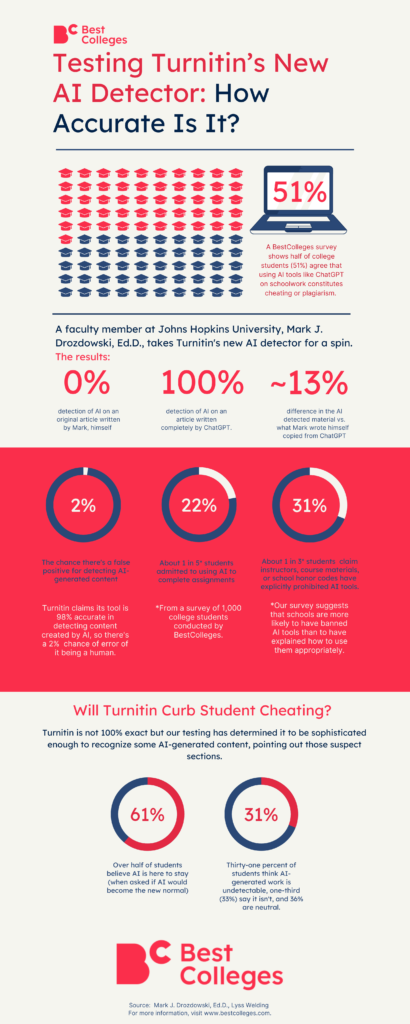
Infographic: AI’s Impact on Education

From Turnitin: An infographic about AI and the impact it’s having on education

Additional reading: 5 Ways Artificial Intelligence Will Transform Higher Education.

Air Force Intel Leak: The Problem with Trusting the Zeros

As we learn more about Jack Teixeira, the Air National Guard enlisted man accused of leaking sensitive intelligence documents over the Discord platform, the more ominous the story gets. New disturbing allegations include Teixeira planning assassinations and other shocking revelations about a young man who should never have had access to national security secrets, but did.

Color me not surprised. This episode reminds me of one of my most unpleasant experiences as a business owner. The IT support person at a web design agency I co-owned in the 1990s was a former Marine who had served with an ultra-elite Force Recon unit in Desert Storm. He was a friendly, clean cut young man to whom I imputed a great deal of honor and trust. This was an error on my part. Consumed with a false fear that he was about to lose his job, this dishonorable veteran took it upon himself to hack our files and email the company’s complete salary list to all our employees—causing irreparable damage to our business.

Military service does not (or should not) imply honor or trustworthiness. 

Military service does not (or should not) imply honor or trustworthiness. I realize this is heresy in this mind-numbing era of “support the troops,” but events show that misplaced trust is deadly. The military and intelligence communities trusted Chelsea Manning and Edward Snowden. How did that work out? Now, here we are, a decade later facing a nearly identical scenario.

What went wrong? David Ignatius offers some ideas in a Washington Post article titled “To stop intelligence leaks, assume there will be bad actors.” Yes, that’s a good idea, and not a moment too soon. David Greenglass, an Army Sergeant, stole nuclear secrets from the Manhattan Project nearly 80 years ago. Since then, we’ve had catastrophic insider attacks from Aldrich Ames, Robert Hanssen and many others.

It would be grossly unfair to say that the military and intelligence establishments do not put effort into stopping malicious insiders, but the results plainly show that their controls are not working. Ignatius cites James R. Clapper Jr., the former director of national intelligence who led the Pentagon’s post-Manning investigation, who said that new rules were established by the DoD after the Manning incident, but, as he put it, “Enforcement was uneven across the Defense Department, and control eroded over time because the restrictions were seen as onerous and inefficient.”

Zero Trust is not a bad idea, but it presents several serious problems.

Ignatius offers a solution, likely whispered in his ear by a defense contractor, which is to implement a “Zero Trust” architecture across the DoD and other areas of the government where secrets lurk. As it happens, Zero Trust is already on the agenda, at least based on the 2021 Biden administration’s Executive Order on Improving the Nation’s Cybersecurity, which stated, “The Federal Government must adopt security best practices; advance toward Zero Trust Architecture.”

Zero Trust is not a bad idea, but it presents several serious problems. One is simply a matter of implementation. Military and intelligence IT infrastructure is complex and layered with ossified and opaque legacy systems. Any changes to them are challenging, and organizational obstacles can cripple even the most well-intentioned efforts.

Indeed, five months after the Biden order on Zero Trust, Nicolas M. Chaillan, the first person ever to be appointed chief software officer of the US Air Force, noisily resigned from his post in exasperation. He was fed up with the fool’s errand he had been sent on to get Air Force software teams to implement DevSecOps, which would embed better security countermeasures into Air Force applications.

Five months after the Biden order on Zero Trust, Nicolas M. Chaillan, the first person ever to be appointed chief software officer of the US Air Force, noisily resigned from his post in exasperation.

Then, there’s the matter of trust itself. Zero Trust architecture assumes that an organization knows whom it can trust. Done right, it can verify the identity of a user seeking access and block untrusted individuals or devices. That’s fine, but Jack Teixeira would have sailed right through a Zero Trust access control layer. Zero Trust should include policies and procedures that avoid having to trust the zeros.

Clappers seem to understand this, because he’s later quoted in the article as saying, “’There needs to be a comprehensive system for monitoring electronic behavior’ at work by people with high security clearances.” It’s impossible to implement controls that will catch every suspicious attempt to access or exfiltrate sensitive data. However, it is possible to deploy AI-driven solutions that can scour internal networks and the worldwide internet itself, for evidence of intelligence leaks.

Zero Trust should include policies and procedures that avoid having to trust the zeros.

If such a system was in operation, it missed Teixeira’s alleged activities. This is an unacceptable failure of controls. What’s needed is more defense in depth, a layering of active controls over access, such as Zero Trust, augmented by passive controls that flag potential leaks before they spread. The Teixeira affair reveals the need for more, better countermeasures of these types.

Differences in SAP Security Solutions: What You Need To Know

Guest post by Christoph Nagy, CEO, SecurityBridge

The application security market is obscure and holds one or two surprises for those looking for an SAP security solution. Cybersecurity solutions for SAP help customers understand the ever-growing threat landscape and protect themselves effectively. In this article, we would like to discuss some points you should focus on when looking for a security solution for SAP.

As the name suggests, SAP Security or SAP Cyber Security solutions are highly specialized software products that can monitor cyber threats, security-critical activities, application configuration, and more. In the case of SAP’s business-critical applications, other aspects such as security patch management and monitoring of interface traffic also become necessary. The distinction between SAP GRC and SAP Cybersecurity is not clear-cut, and therefore, it is often needed to think of an integrated approach.

SAP Cybersecurity products are divided into solutions and platforms. In contrast to a solution that usually covers a single topic area, an SAP Security Platform takes a holistic approach to protect customer data. Unfortunately, it is not always easy to tell from the glossy brochures of the suppliers whether a platform product is not a single solution.

A real platform characterizes itself when the customers’ maintenance effort (TCO) is reduced thanks to the software architecture. This is the case when a central basic configuration exists on which the security applications are based. Also, the platform should not require you to update each SAP security application individually. The platform gets an upgrade. The special added value of the real platform approach is that the security applications exchange necessary information and expand the user’s view in a systematic form. When properly implemented, the end user can always access all the crucial information needed to evaluate a security incident.

Spot vs. Platform SAP Security

If you look around for SAP security applications, you will quickly realize that there are not only solutions with different functional scope and depth but also different architectural approaches. Which one suits you best depends on the application and purpose.

The integrated approach relies on a software architecture that tries to extend the SAP application’s technology stack with required capabilities to protect the crown jewelry. A particular advantage of this approach is that usually no additional hardware (or virtual appliances) is required. These are often forgotten in the cost analysis and the licensing costs and lead to a nasty surprise in the implementation project.

In contrast, there is also an external solution that accesses the SAP application via an interface and attempts to read out the data necessary for security analyses.

This approach advertises a reduced footprint on the application, which looking closely, is often not so small. External security applications are certainly an excellent choice for closed systems where customers cannot install plugins. However, this does not apply to SAP because, just like with operating systems, you can use additional add-ons. Since this article is about a security solution to protect SAP, it is crucial to note that additional software and appliances often introduce new attack vectors that the customer must analyze. If an attacker can exploit a vulnerability in a security solution, the solution becomes a problem for SAP security. So, check the selected SAP Security Solution for security vulnerabilities and standard security measures brute force protection (2FA), remote access, and update architecture.

External vs. Integrated SAP Security

In this section, we look at the functional scope of an SAP Cybersecurity Solution. A word of caution – No matter what the provider promises you on the website or in glossy brochures, you should form your own opinion in any case. It has already happened that product comparisons were wrong or biased. Be sure to ask for a demonstration of the features you want, and if in doubt, ask for a test installation. Make sure the product you want to buy is used during the test!

Now to the functions you need as an SAP customer. On the one hand, there are four functional vectors that SAP security solutions should cover. Depending on your requirements profile, you may, of course, only be interested in one area. But at the end of the day, to effectively protect SAP against cyberattacks, you must address all of them.

Consider the following functions:

Patch Management

Vulnerability Management

Threat Detection

Code Vulnerability Analysis  

Of course, the functional depth, which details what the selected solution offers you varies among manufacturers. Therefore, we advise you to create a requirements list of the required functions, which will help you with an objective evaluation.  We believe in transparency and openly disclosing what is covered and what features are on the roadmap. Be sure to ask for a product roadmap to learn from the vendor of your choice if there is a solid innovation plan. Especially in cybersecurity, innovation is necessary to prepare for the rapidly changing risk situation.

When should you look for SAP Security solutions?  Fundamentally, it is true – it is never too early, but it could be too late.  According to this principle, you should prefer proactive actions to reactive ones. Especially, when it comes to securing critical enterprise infrastructure and applications such as SAP.  Here are some examples:

If you are a CISO, Chief Information Security Officer, or a CRO, Chief Revenue Office, and you feel that your SAP systems are not patched regularly, and on time, you should look for a solution.

If you are an SAP Basis manager who cannot keep up with monitoring security-related settings, you should look for a solution.

If you manage ABAP developments and notice that the established code quality checks do not sufficiently cover security aspects, you should look for a solution.

If you are responsible for the integration and can no longer say with certainty whether all SAP RFC connections are sufficiently hardened, you should look for a solution.

Christoph Nagy has 20 years of working experience within the SAP industry. He has utilized this knowledge as a founding member and CEO at SecurityBridge–a global SAP security provider, serving many of the world’s leading brands and now operating in the U.S. Through his efforts, the SecurityBridge Platform for SAP has become renowned as a strategic security solution for automated analysis of SAP security settings, and detection of cyber-attacks in real-time. Prior to SecurityBridge, Nagy applied his skills as a SAP technology consultant at Adidas and Audi.


Guest Post: Data Security in the Cloud: Why It Matters and How to Get It Right

By Eric Sugar, President — ProServeIT


As the cloud continues to grow in popularity, more and more businesses are moving their operations to the cloud. While this can provide many benefits, such as increased flexibility and scalability, it also brings security challenges. With cybercrime on the rise, data security in the cloud has become a critical issue that cannot be ignored.


Data is the lifeblood of modern businesses. It is what enables them to make informed decisions, develop new products and services, and stay competitive. When data is lost, stolen, or compromised, the consequences can be severe. Businesses can suffer financial losses, reputational damage, and even legal consequences.


With the cloud, data security is particularly important. First, businesses need to make sure to choose a reputable cloud provider such as Microsoft. Second, while these providers offer many security measures, businesses still need to take responsibility for their data.


Understanding the shared responsibility model

The shared responsibility model is a critical concept in cloud computing that defines the security responsibilities of both the cloud provider and the customer. This model helps to ensure that both parties understand their respective roles and responsibilities in securing data in the cloud.


In the shared responsibility model, the cloud provider is responsible for securing the cloud infrastructure, including the physical security of data centers, network security, and server security. This includes ensuring that their cloud environment is protected against common cyber threats, such as malware, distributed denial-of-service (DDoS) attacks, and unauthorized access.


At the same time, the customer is responsible for securing their own data and applications in the cloud. This includes setting up strong access controls, implementing encryption, and ensuring that their data is backed up and recoverable in the event of a disaster.


The shared responsibility model is critical for ensuring data security in the cloud because it helps to eliminate confusion about who is accountable for specific responsibilities. It also helps ensure that both the cloud provider and the customer are held accountable for their respective security responsibilities.


By understanding the shared responsibility model, businesses can take steps to ensure that their data is secure in the cloud. For example, they can work with their cloud provider to ensure that they have implemented appropriate security measures, such as firewalls, intrusion detection and prevention systems, and data encryption. They can also implement their own security measures to protect their data, such as multi-factor authentication, role-based access controls, and data loss prevention tools.


Conducting a risk assessment

Before moving data to the cloud, businesses should conduct a risk assessment to identify potential security risks. This assessment should include a review of the cloud provider’s security measures as well as an analysis of the business’s own security practices. By conducting a risk assessment, businesses can develop a better understanding of the security threats they face and take appropriate measures to mitigate those risks.


The first step in conducting a risk assessment is to identify the data that is most valuable and sensitive, such as customer data, financial data, and other critical business information. Once this data has been identified, the next step is to assess the potential risks associated with storing this data in the cloud, including risks such as data breaches, unauthorized access, and data loss.


Once the risks have been identified, the next step is to assess the likelihood and potential impact of these risks. This can involve analyzing historical data breaches, assessing the strength of existing security measures, and evaluating the potential impact of a breach on the business.


Based on the results of the risk assessment, businesses can develop a comprehensive security plan that addresses the identified risks and vulnerabilities. This plan can include measures such as implementing stronger access controls, increasing the use of encryption, and conducting regular security audits and assessments.


Conducting a risk assessment is critical for ensuring data security in the cloud because it helps businesses develop a better understanding of the potential risks they face. By identifying these risks and assessing their potential impact, businesses can take appropriate measures to mitigate those risks and protect their data. This subsequently helps prevent data breaches, unauthorized access, and other security incidents that can have a significant impact on the business.

Implementing strong access controls

Access controls are critical to data security in the cloud. Businesses should implement strong access controls that limit access to sensitive data to only those who need it. Multi-factor authentication, encryption, and role-based access controls are all effective ways to limit access to data.


Monitoring and managing cloud environments

Implementing strong access controls is a critical step in ensuring data security in the cloud. Access controls are security measures that are put in place to regulate who has access to data and resources in a cloud environment. By implementing strong access controls, businesses can ensure that only authorized users have access to their data and that the risk of unauthorized access is minimized.


There are several ways in which businesses can implement strong access controls in the cloud. One approach is to use multi-factor authentication (MFA) to verify the identity of users. MFA requires users to provide more than one form of identification — such as a password and a biometric scan — to access cloud resources, preventing unauthorized access by requiring an additional layer of verification beyond a simple password.


Another approach is to implement role-based access controls (RBAC). RBAC is a method of assigning specific roles and permissions to users based on their job responsibilities. This helps ensure that users only have access to the resources they need to do their jobs and reduces the risk of unauthorized access to sensitive data.


Businesses can also implement access controls by using network segmentation to isolate sensitive data from the rest of the cloud environment. Network segmentation involves dividing the cloud environment into smaller, isolated networks that can be accessed only by authorized users.


Data security in the cloud is something all businesses should pay attention to. And while these three steps to doing it right are valuable, nothing is as valuable as your team and a security partner that you work with to manage data security. With the right mindset and trusted cloud experts, businesses can take advantage of the many benefits that the cloud offers while minimizing the risks.


Eric Sugar is the President of ProServeIT. With over 20 years of experience working in the information technology and services industry, he cares deeply about helping businesses become digital and maintaining digital data security.

Honda’s Engineering Failures and the Organizational Side of Digital Transformation

A year ago, I wrote about El Al’s and American Airlines’ epic failures in rules-based systems and digital transformation. My point then was that digital transformation must involve deep thinking about the total customer experience, not just a narrow focus on systems and code. I am back on this beat to discuss a comparable set of failures on the part of Honda, maker of my 2022 Civic.

I am generally forgiving of lapses in service from major corporations. I’ve worked in large enterprises, so I empathize with the challenges of getting a lot of big moving parts to align. A mistake is a mistake. Forgive and move on. However, with Honda, the failures in product design and accompanying support are so pervasive that it reveals an underlying organizational rot—a rot that shows how difficult it can be to execute a digital product strategy.

Having attended business school in the early 1990s, I was raised to believe that Honda and its fellow Japanese manufacturers were working at a higher level of design and product marketing than their American counterparts. They could do no wrong, as they swept up market share with superior products at competitive prices. Every aspect of a car’s design was carefully thought through and executed with consumer-facing perfection.

How the mighty have fallen. My first brush with the peculiarities of a too-digital car occurred when I had to have my Honda towed. (I’d lost my key fob, a digital convenience that turned into a hassle when it disappeared.) There was no mechanical parking brake release in this electronics-heavy car. At least, none that I or the tow truck driver could find. Without the key fob, the car was anchored to the street. The tow truck had to drag the car up onto its bed to take it to the dealership, a time-consuming chore that could have damaged the car.

Then, my battery ran down when it was -7 degrees outside (-20 with wind chill). The electronic key fob did not work because there was no power. The hole for the backup key was not visible, so as my fingers froze, I finally realized the keyhole was hidden under the door handle. Whoever thought that up deserves a medal for absurdly bad design. It required three hands to manage, and even then, it took a good ten minutes to get the key to work. I risked frostbite to open my car door.

Then, because I’m not a car person, and it was pitch black outside, I could not find the hood release. I looked in the manual, but there was no reference in the index for how to release the hood. I finally found a YouTube video that explained it.

More recently, my son managed to lock himself out of the car while the engine was still running. For reasons that I cannot fathom, this switches off the car locks. We stood there watching the car run, unable to open the doors or the trunk. There is probably a security reason for this vehicular software design decision, but I cannot imagine what it is.

No problem. That’s what Honda Roadside Assistance is for, right? I called them and explained what was going on. I was sure they would have some simple fix, like click your heels together and say you want to be back in Kansas and the car will open. But no, the guy on the line had never heard of this problem. I suppose I was the first person in the history of this company to ever lock himself out of his car. He had nothing to offer other than sending a tow truck to give me a jump start. Sir, I said, my car is already running. I don’t need a jump start. He arranged for me to be towed to the dealership. I wasn’t sure what that would accomplish, but that was all he had on his rules-based system and its customer service scripts.

I called the dealership and asked if they could help me. They said they didn’t give mechanical advice over the phone. You’re welcome. They’d apparently never heard of this issue, either. Honda for the win, again.

A few minutes later, the car switched itself off and the doors unlocked. Why hadn’t the roadside assistance operator or dealership known about this? That would have required someone, or more likely some team of people, actually thinking through what happens when you drive a Honda civic in the real world. It would have required some coordination between the design team, the people who write the manuals and those who support the car once it’s been sold. None of that was happening.

Digital product transformation is a complex challenge in both technological and organizational terms. Cars now contain millions of lines of code. They are designed and manufactured through completely digital processes. The results can be impressive, but so can the unintended problems.

Each digital feature, like an electronic parking brake or an automated lock down if the motor is running, should be accompanied by some deep thinking about what can go wrong when these features cause unexpected difficulties. If the Honda of yore was still functioning, someone would have anticipated trouble and either changed the design or, at a minimum, made sure that roadside assistance had the information it needed to help customers solve the problem. Maybe it’s time for some analog transformation at Honda.


Photo by Liviu Gorincioi: https://www.pexels.com/photo/blue-car-parked-on-street-10339803/

Ethical Scraping: A Conversation with Rayobyte’s Neil Emeigh

I sat down recently with Neil Emeigh, CEO of Rayobyte, to discuss one of his favorite subjects: ethical scraping. According to Emeigh, Ethical scraping refers to the practice of collecting consumer data in a way that is respectful of users’ privacy and legal rights. He explained, “At Rayobyte, we believe that ethical data collection is a crucial part of the tech industry, and we’re proud to offer our products in a way that reflects this belief. When we source proxies, we always do so with the user’s knowledge and consent. We also ensure that the scraped data is used for legitimate purposes. Our goal is to provide each individual customer with a truly ethical and reliable experience and in return, we also require them to scrape within the legal boundaries of the United States. That legality often doesn’t permit the collection of consumer data that is protected by logins, and we also don’t allow such use cases ourselves.”


The rest of the conversation went like this:


Q:           How does the legality of web scraping affect the collection of consumer data?
A:            The legality of web scraping can have a significant impact on the collection of consumer data. In many cases, the collection of data through web scraping can be legal, as long as it is done in a way that respects users’ privacy and follows relevant laws and regulations. However, there are also cases where web scraping can be illegal, such as when it violates copyright, trademark, or other intellectual property laws, or when it violates anti-spam or anti-fraud laws.


At Rayobyte, we take the legality of web scraping very seriously, and we make sure that our customers follow all relevant laws and regulations when collecting consumer data. However, the legal landscape around web scraping is an evolving one, and we work closely with our customers to ensure that they are aware of any major legal changes.


Q:           What is the role of proxy services in ensuring ethical web scraping practices are followed?


A:            That’s a great question! I want to say proxy services play a crucial role in ensuring that ethical web scraping practices are followed by our customers. We can enforce ethical web scraping practices by providing our customers with clear guidelines and terms of service that outline what is considered ethical web scraping. This includes avoiding overloading a website with too many requests, respecting website terms of use, and making sure not to collect data outside publicly available sources.


What makes Rayobyte different is we go the extra mile to monitor our customers’ scraping activities and take appropriate actions if we detect any illegal behavior. This includes terminating service or blocking IP addresses if a customer is found to be engaging in illegal or unethical web scraping practices.


Overall, our role as a proxy service provider is to ensure that our customers can access data in a legal and ethical manner while protecting the privacy and security of internet users. We take pride in our commitment to ethical web scraping practices and strive to promote these practices within the industry.


Q:           In your experience, why do current methods of web scraping often fail to protect consumer data?


A:            Well, you know, the thing is, some web scrapers just don’t play by the rules, and that can put consumer data at risk. It’s important to follow ethical scraping practices and use trusted data sources to avoid collecting inaccurate or irrelevant data. Another reason could be the lack of clear guidelines and standards in the industry, which can make it challenging to ensure that user data is being protected. This is why we are also actively working to build an initiative called EWDCI – Ethical Web Data Collection Initiative, with fellow ethical proxy providers.


Q:           What steps can consumers take to safeguard their data when it is being collected through web scraping?


A:            Assuming by “consumers,” you mean people like you and me, the regular people, we go to the internet every day and interact with each other on social media, search for stuff we need, and so on~ I’m not sure we can continue living the way we are if we get too protective about keeping all our data to ourselves. Of course, we should be wary about sharing any sensitive information, but we also shouldn’t become too protected that we hamper our daily lives. We have to accept that we live in an era of free flow of information and acknowledge that to enjoy the perks of this era, we also have to participate in it. The important thing, in my opinion, is to decentralize the data, so that a few monopolistic entities can’t govern that. By offering the infrastructure to scrape, we give the power back to people in the sense that the utilization of data becomes democratic, and more use cases continue to benefit us without necessarily hampering the existence of that data in web.


Q:           How can companies and individuals conducting web scraping ensure their practices are compliant with privacy laws and regulations?


A:            So, if you’re a company or individual conducting web scraping, it’s essential to ensure you’re following the rules when it comes to privacy laws and regulations. That means doing your homework and understanding what’s required of you in terms of consent, data security, and transparency. It’s also crucial to use reputable proxy sources that you can trust, so you know that your effort to maintain ethics isn’t wasted. As I said that the legal landscape of web scraping is definitely an evolving scenario, so continue to keep yourself updated as well.

A:            How do proxy services factor into the equation when it comes to making web scraping more ethical and privacy-sensitive?


Q:           As a proxy provider, Rayobyte takes a proactive approach to promote ethical and legal web scraping practices. We require our customers to fill out a thorough “know your customer” form before allowing them to use our proxies, and we use various forms of monitoring & user authentication to enforce our ethical and legal policies.


While this approach may result in losing some potential customers, and we’ve had a fair share of them, we believe that it’s important to maintain a high level of accountability and responsibility to protect user privacy and promote responsible use of our services. I encourage other proxy services to start gatekeeping the same way if they’re not already.


Q:           In your opinion, what are the future of web scraping and data privacy, and how will these fields continue to evolve?


A:            The industry is rather new, and more & more people are becoming aware of how they can utilize data and enable their businesses to grow exponentially. When we continue to find more use cases, of course, more and more privacy concerns may also arise, which, by the way, is something we will always encourage.


I think the next big step for the scraping world would be to have a properly defined ethical use case that doesn’t vary state by state. And we can also contribute to the dialogue should the legislators ask to help shape how the ethical world of scraping looks like, for everyone involved. The use of data continues to benefit humanity, and I sincerely believe there is a win-win situation we can find involving all stakeholders.

An example of such a solution is Cash Raven. A product we’ve recently been working with that allows users to ‘rent out’ their IP addresses when they are not using and enables them to earn passive income that generates from the users who happens to lease the idle internet.


I reckon more innovative solutions like this will continue to surface.


Q:           Can you provide any examples of companies or organizations that have successfully implemented ethical web scraping practices and maintained consumer privacy?


A:            I am proud to say that so far that has been all our customers. We have a zero-tolerance policy for anything shady and we constantly monitor how our proxies are being used. So that’s all of our customers.

The key to data privacy: Giving consumers control

Here is how we can achieve a perfect day in data privacy.

By Aubrey Turner, Executive Advisor, Ping Identity

Businesses’ appetite for gathering (and monetizing) personal data is increasingly at odds with consumers’ growing concerns about how that data is used. More than three-quarters of consumers now feel they will never be fully in control of their personal data online, and still blindly accept the fine print terms and conditions that allow businesses to profit from their data.

Data Privacy Day is an opportune time to renew the debate about reshaping data privacy laws that put consumers’ needs first. Americans would benefit greatly from a national consumer bill of rights of sorts, with protections similar to the European Union’s GDPR privacy laws, rather than the menagerie of state- and sector-specific laws that comprise U.S. data privacy regulations today. Unfortunately, too many U.S. businesses don’t fully reveal how customer data is being used, often exploiting gaps in existing regulations and public awareness.

If businesses want to earn consumer trust long-term, they need to make data privacy a consumer-first matter. With every daily digital interaction, there is a new opportunity to not only keep customers happy, respected and protected but help the business stay ahead of the competition by providing a digital experience that is both seamless and secure.

But what would a consumer data privacy bill of rights look like in the real world? How would their digital life unfold if businesses implemented privacy measures that consumers want?

First, consumers would clearly be able to see when their data is being collected and shared by a business when they interact. They can retrieve their personal data from every business, and easily revoke or set personal preferences for how it is used. No personal data is sold or shared between other entities without notifying consumers and gaining their consent.

On the businesses’ side, they will no longer voraciously collect every piece of personal data from a user, only to figure out how to monetize it later. Instead, they collect the bare minimum, provide consent and data management controls on the fly, and dispose of any collected data that is not used within a limited time period.

Adopting progressive profiling is one-way businesses can make this transition. Progressive profiling is a consumer-friendly, privacy-compliant way to collect personal day. It limits what data is collected about the consumer by gathering smaller amounts of information incrementally instead of all at once. Rather than inundate new users with questions and sign-up forms, businesses that adopt progressive profiling collect personal data gradually over time as a customer uses their product or service. It minimizes friction while delivering a happier customer experience. Businesses can also incentivize consumers to share more information as the relationship, and trust, between customer and brand grows.

Next, consumers will no longer feel like their smart speakers, smart TV, wearables and other digital devices with listening and monitoring capabilities are spying on them. Consumers will no longer experience the intrusive pop-up ads and emails for products or services that they just casually mentioned in conversation.

Consumers won’t receive any unsolicited emails and texts either. When making a one-time purchase from a business that they may never engage with again, they won’t receive any emails or texts from the business attempting to lure them back by offering deals and discounts.

On social media, consumers will now know what information about them is shared to tailor targeted ads and provide easy ways for them to update that information whenever they want. And when visiting websites for the first time, consumers aren’t forced to respond to any website requests for cookies. At the very least, when presented with a cookie banner, consumers can simply click a “reject all” button rather than having to check/uncheck a long list of preferences.

Data privacy policies will also be easy to understand. When businesses disclose their policies on the website, consumers no longer have to deal with terms of service agreements that are so complex that individuals simply give up and “accept all” without truly understanding the agreement.

Consumers can also do a quick review at any time via a credentialed, digital wallet to see which businesses have access to their data. The digital wallet can identify which businesses no longer serve the consumer and easily revoke access.

While the GDPR model may not fit perfectly within the U.S. system, we need some kind of comprehensive federal privacy law. A consumer data privacy bill of rights can free consumers from that helplessness they feel each time they are required to provide information to businesses, or when data is passively collected without transparency, fearful of how that data may be exploited.

Aubrey Turner

Instead, businesses should realize that, as consumers become more aware of their data autonomy, enhanced data privacy can create a business advantage. If businesses want to earn consumer trust long-term, they need to make data privacy a matter of trust and choice. With every digital interaction, they gain a new opportunity not only to keep customers informed, empowered, and protected but also to help the business stay ahead of the competition.